
renewable energy data becomes wearable design
STEFAN SAGMEISTER AND EKN TURN DATA INTO WEARABLE DESIGN
Stefan Sagmeister is taking his data visualizations somewhere they rarely go: onto people’s feet. In collaboration with Frankfurt-based ekn footwear, the Austrian graphic designer has developed a sneaker and a boot that translate statistics on renewable electricity and street homelessness into wearable objects. The two designs accompany his exhibition Finally, Something Good., opening at La Gaîté Lyrique in Paris on October 15, 2026. Rather than simply reproducing existing artworks on footwear, the project brings together graphic design and traditional shoemaking. ‘It was about seeing what happens when Stefan’s way of thinking meets our way of making things,’ ekn founder Noel Klein-Reesink tells designboom in an exclusive interview.
For Sagmeister, the attraction lies in reaching an audience beyond the exhibition space. ‘A painting in a gallery or museum is seen by people who decided to come in and look. A shoe is seen on the street by people who decided nothing of the sort,’ he explains to designboom. The collaboration extends his ongoing exploration of long-term social progress through visualized data, previously presented across historic paintings, installations and everyday objects. Klein-Reesink sees a natural connection between this approach and footwear design. ‘What has always interested us about his work is the way he turns complex information into something immediate and visual,’ he says. Here, the artwork no longer has to wait for visitors. It can catch their attention on the way to the supermarket.
RENEWABLE ENERGY AND HOMELESSNESS SHAPE TWO SHOE DESIGNS
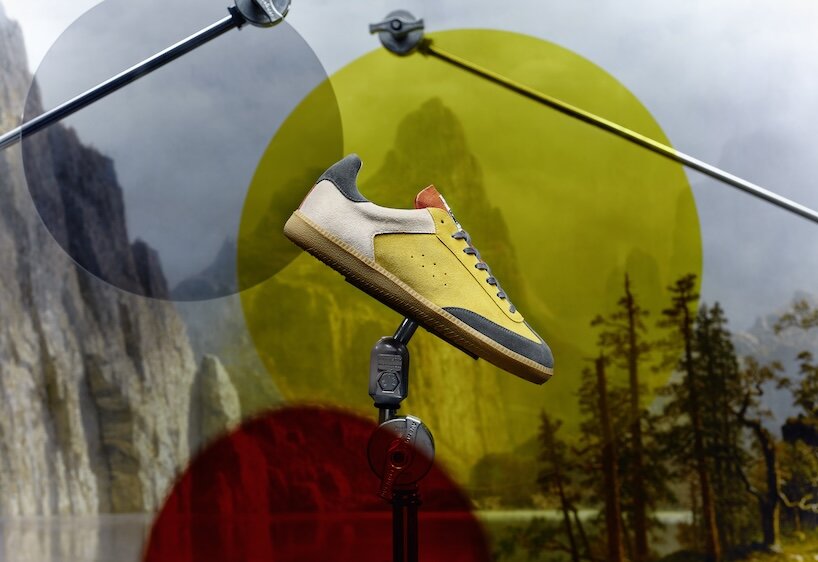
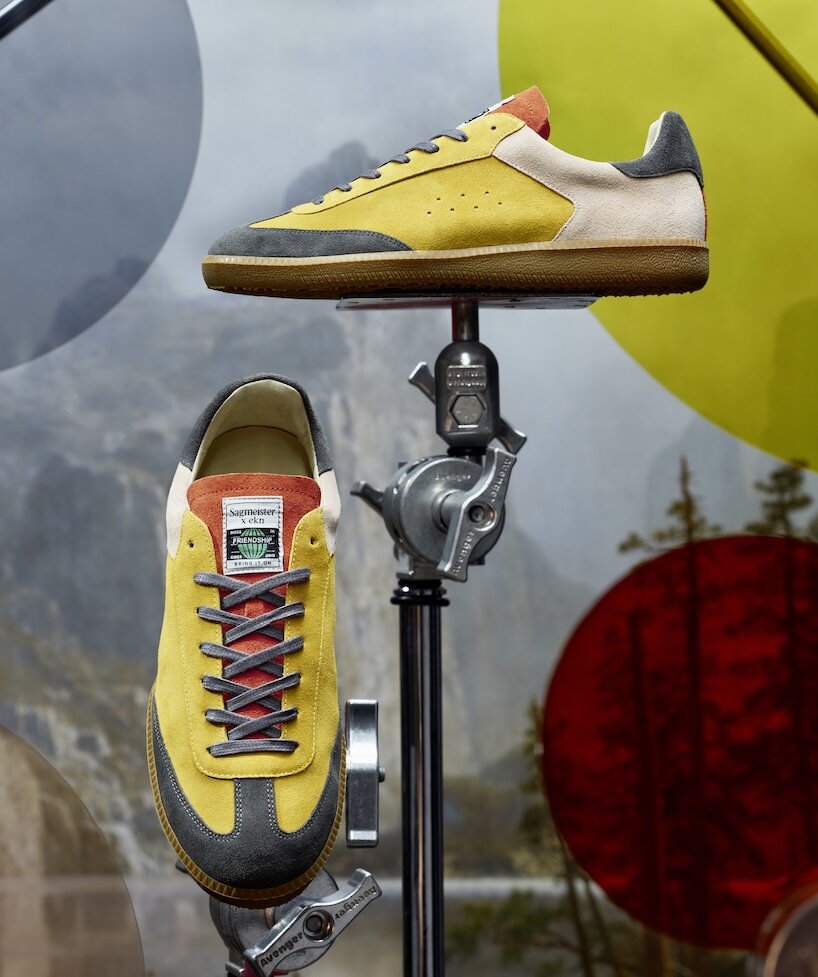
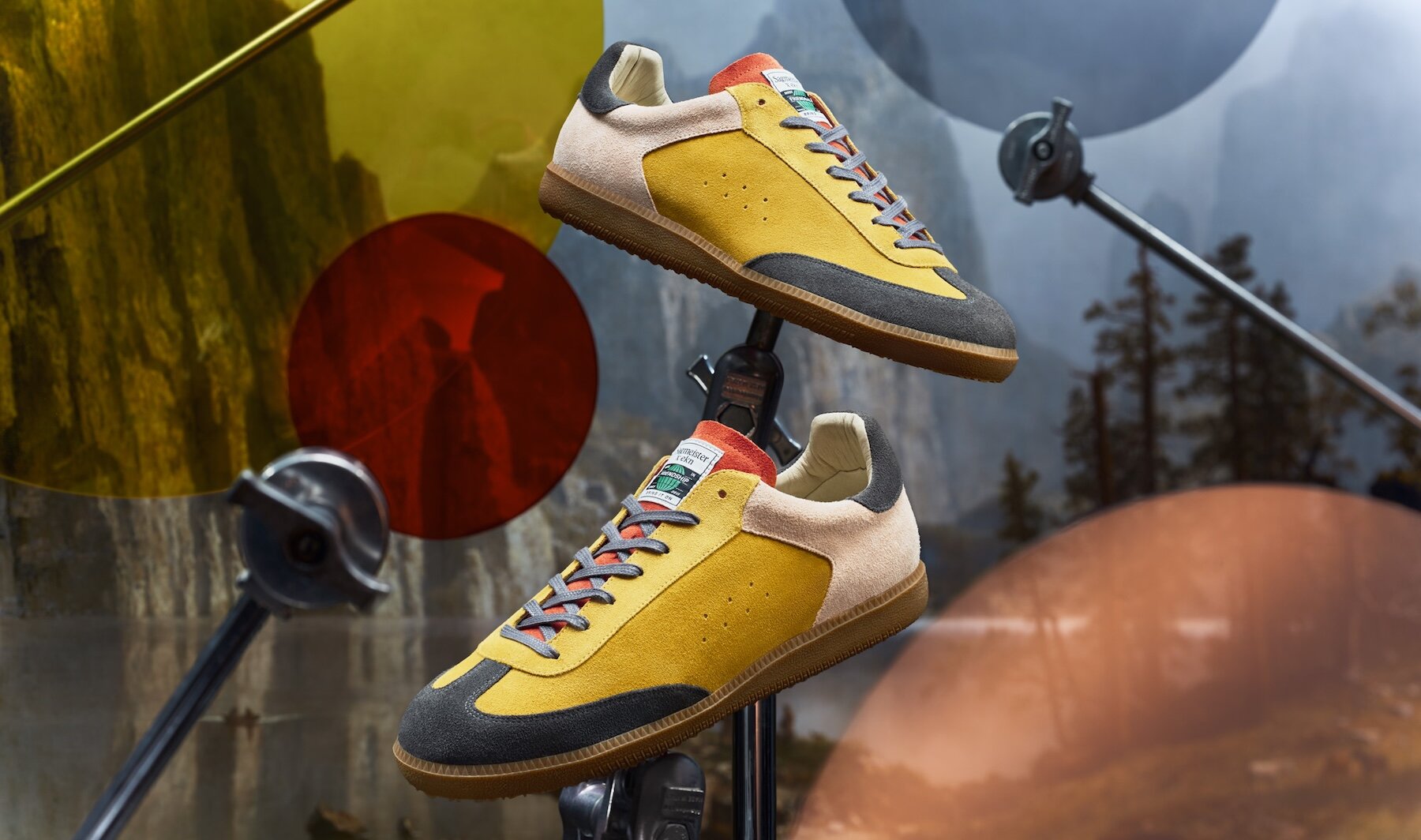
The first model, Bring It On, is a colorful suede sneaker visualizing worldwide renewable electricity generation between 1965 and 2022, including hydro, wind, solar and other renewable sources. The rising figures become a graphic composition across the shoe’s upper, while the complete dataset appears on the footbed. ‘With Bring It On, the shapes and colours became part of the overall design of the sneaker, while the complete information sits on the footbed,’ explains Klein-Reesink from ekn. For Sagmeister, the subject carries particular significance. ‘While everybody is talking about AI, I find the improvement in renewable electricity generation more consequential,’ he tells designboom, pointing to the possibilities that cheaper renewable energy could unlock, from vertical farming to desalination and carbon capture.
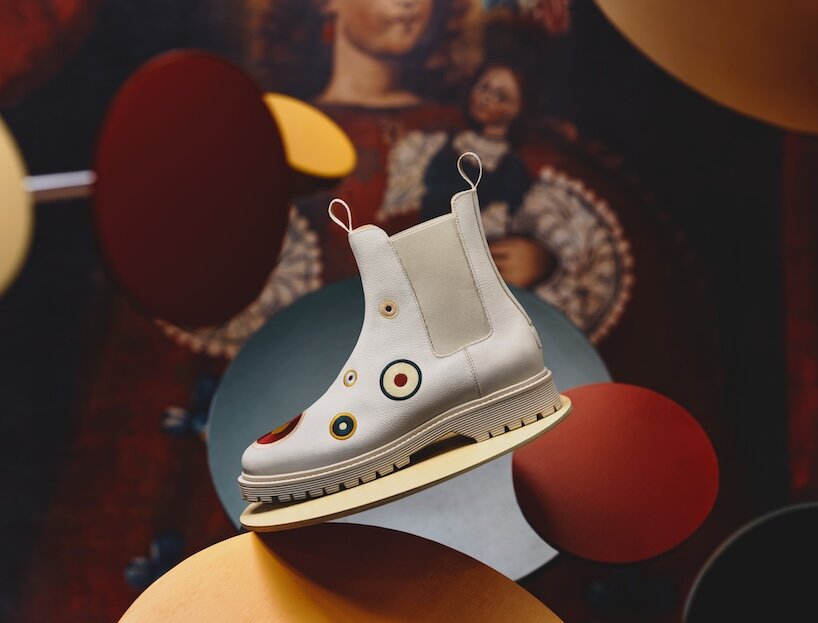
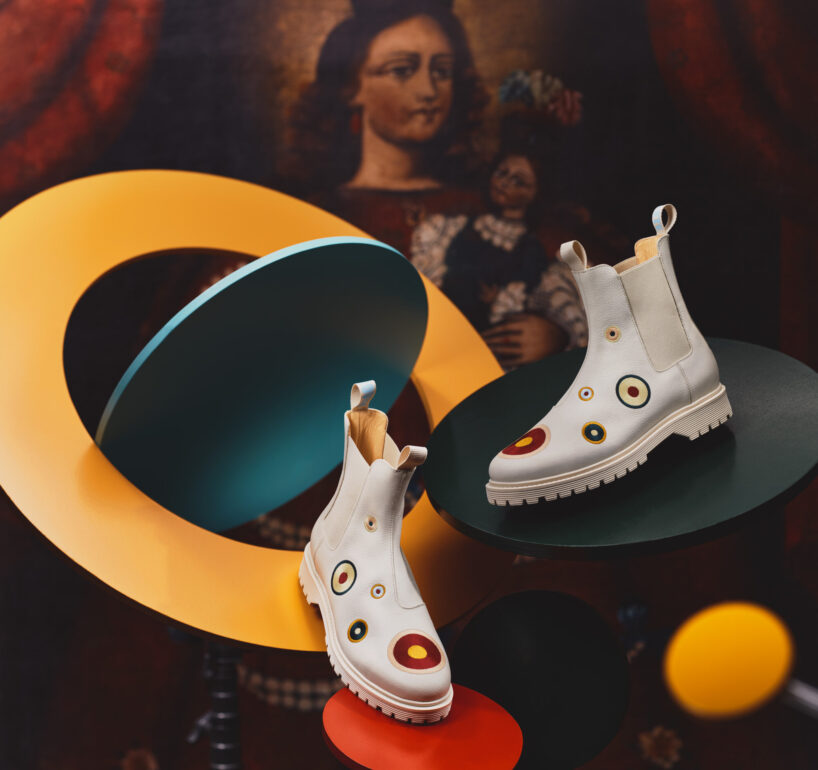
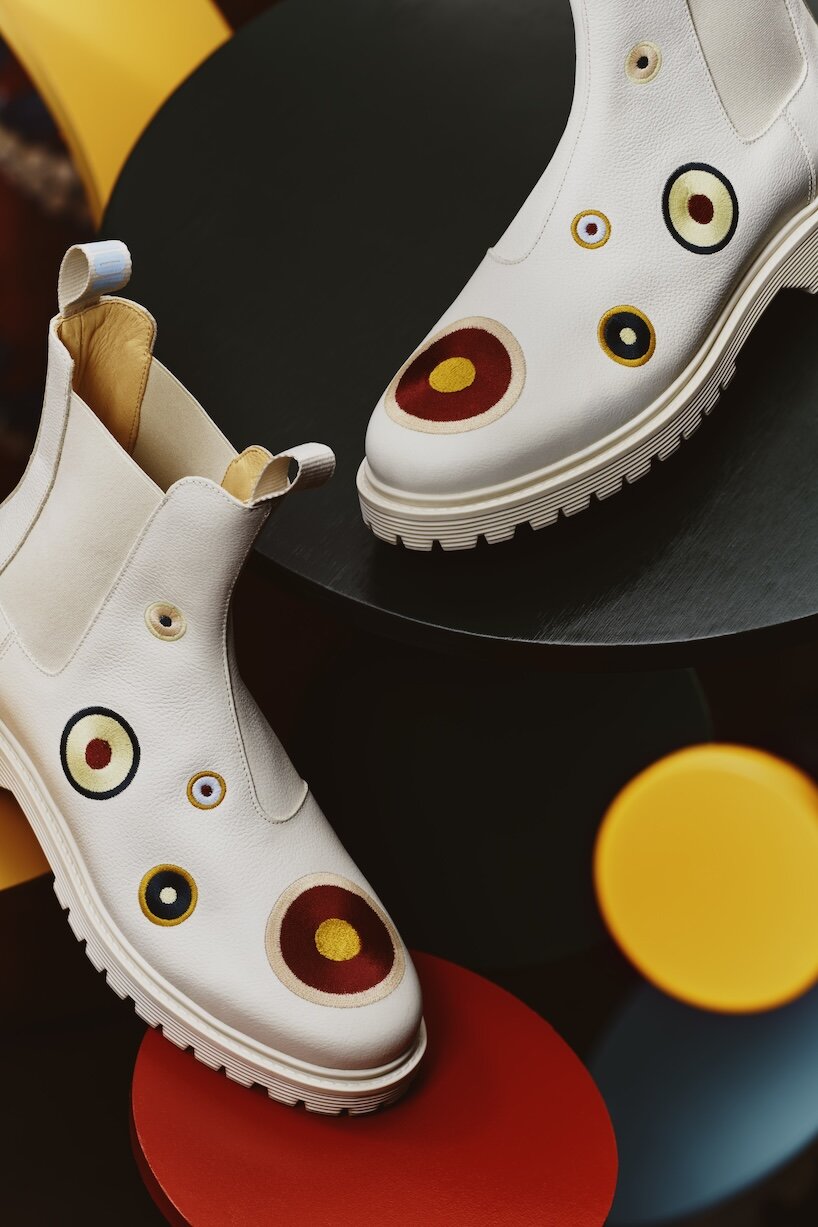
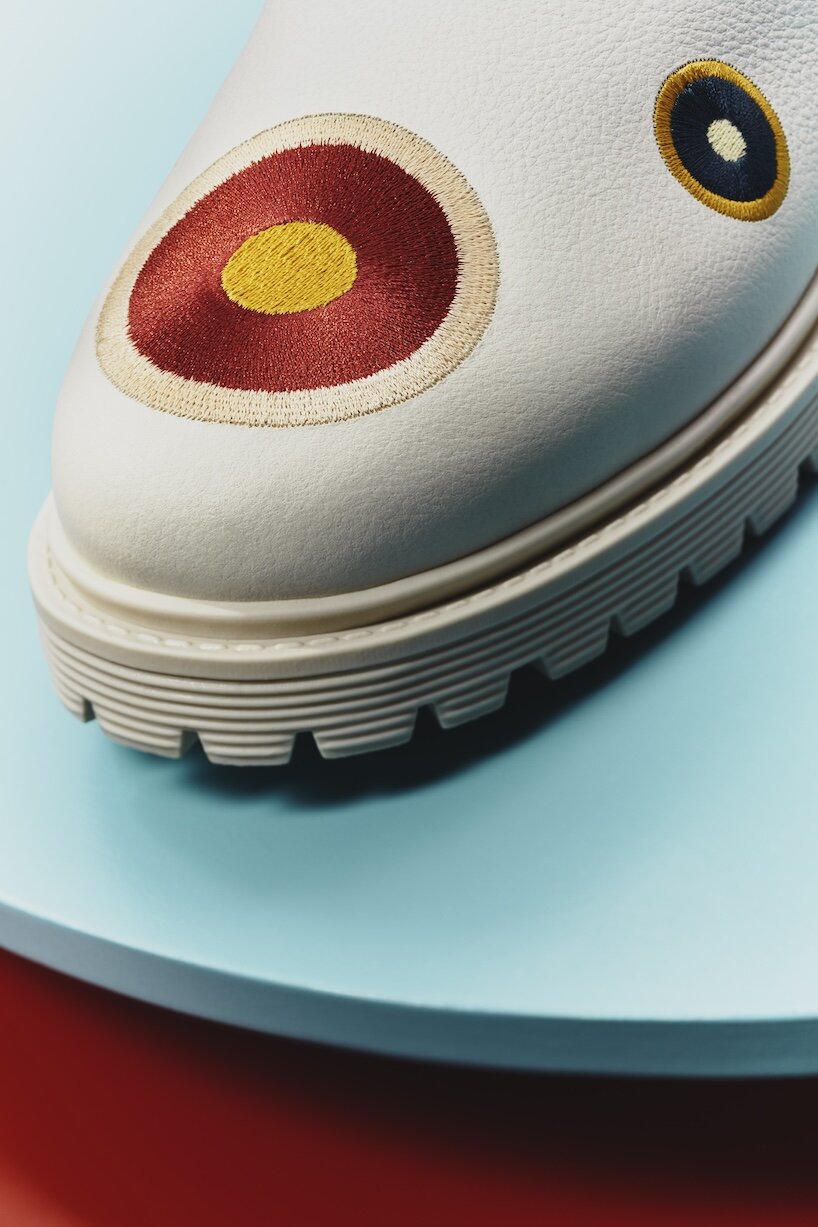
The second design, Like a Complete Unknown, takes a more uncomfortable subject and gives it the form of a cream-colored leather boot. Its embroidered graphics visualize reported street homelessness across six countries, drawing on the OECD Affordable Housing Database. The figures range from 76 people living on the street or in public spaces per 100,000 inhabitants in the United States to 46 in Germany, 16 in the United Kingdom, eight in France, five in Mexico and two in Japan. ‘For Like a Complete Unknown, the graphic is embroidered directly onto the leather,’ Klein-Reesink explains. Sagmeister is equally direct about the limitations of the comparison: ‘The numbers are not perfect.’ Different national definitions and collection methods mean that the figures cannot be treated as an exact measure of relative homelessness. Yet the designer argues that imperfect statistics can still open discussions that might otherwise remain abstract.
EKN BRINGS SAGMEISTER’S GRAPHICS TO FOOTWEAR
Turning the graphics into functional footwear required more than choosing where to place a colorful motif. Both designs build on existing ekn silhouettes, adapting the original visualizations to the curves, panels and construction of each model. The sneaker uses chrome-free tanned suede, while the boot combines chrome-free tanned smooth leather with embroidered graphics. According to Klein-Reesink, the process involved repeated exchanges with embroidery specialists and manufacturing partners in Portugal. ‘It was a very practical process. You make a sample, look at the actual shoe, change a detail and try again,’ he explains. The challenge was to preserve Sagmeister’s visual language without forgetting the rather essential requirement that the finished objects should still work as shoes.
The collaboration also raises a question that neither partner appears interested in avoiding: what does it mean to sell a luxury-priced boot addressing homelessness? ‘There is something awkward about a 350 euro boot that carries homelessness data, and I don’t think a donation makes that go away,’ Sagmeister acknowledges. The boot retails for €350, while the sneaker costs €300. Ten percent of each sale will support organizations connected to the respective subjects: €35 from each boot goes to the Coalition for the Homeless in New York, and €30 from each sneaker to Future Cleantech Architects in Germany. As Klein-Reesink explains, ‘ten percent of the retail price goes to organisations working in the respective fields.’ The donations do not resolve the tension between the products and their messages, but they form part of an attempt to connect the visualized information with action beyond the objects themselves.
EKN FOOTWEAR EMBRACES MADE-TO-ORDER PRODUCTION
Both models are handmade at a footwear workshop in Portugal and will be produced through a limited pre-order system rather than manufactured in advance. Orders will be accepted from October 14 to November 15, 2026, with delivery scheduled for January 2027. Available in EU sizes 36 to 46, the shoes will enter production according to actual demand, an approach intended to reduce unsold stock. ‘The main advantage is very simple: after the pre-order period, we know how many pairs people actually want,’ Klein-Reesink explains. For the founder, who established ekn in 2015, the system reflects a broader philosophy of responsible manufacturing. ‘Sustainability is not only about choosing a better material,’ he adds, emphasizing the importance of production methods, durability and quantities.
Ultimately, the project returns to a relatively simple proposition: information becomes more accessible when it enters everyday life. Sagmeister’s exhibition Finally, Something Good. examines the distance between public perceptions of the world and measurable developments over time, using visual culture to question the often overwhelmingly negative narratives of contemporary life. These two shoes carry that investigation onto the street, where a graphic might initially attract attention for its colors or unusual composition before revealing what it represents. ‘For us, good design also means making something properly and making it to last,’ Klein-Reesink says. Whether wearers end up discussing renewable energy, homelessness or simply their new shoes remains open. For Sagmeister, the exchange itself is what matters: ‘That conversation is the piece.’
project info:
name: Sagmeister × ekn footwear
designer: Stefan Sagmeister | @stefansagmeister
partner: ekn footwear | @eknfootwear
exhibition dates: October 15, 2026 – April 18, 2027
pre-order: October 14 – November 15, 2026
The post stefan sagmeister and ekn transform global data into colorful sneakers and boots appeared first on designboom | architecture & design magazine.